2.2.07

art... Vik Muniz

Vik Muniz
Artist's Talk for "Pictures of People"
BALTIC
31 Jan. - 15 April

Self Portrait (Fall No 2), 2005


Marlene Dietrich (Diamond Divas), 2004


Creature from the Black Lagoon (Caviar Monsters), 2004

Bloody Marilyn, 2001


Double Elvis (Pictures of Chocolate), 1999


For this recent show at the BALTIC, Muniz' work has been organised under the category of portraiture; an interesting art-historical claim to be sure. More than play with notions of the portrait, Muniz offers visitors a fun and accessible entry point into the contemporary discipline of visual studies. As a photographer, he remains quite conscious of the visual dilemma of our present culture. In a word, we suffer from saturation, a drowning in the sea of visual stimuli. Under such a burden, it seems the visual image has come to have less and less effect upon its intended target. For his work, Muniz has selected both those tired images of pop culture cliché and the touchstone monuments of art history in order to re-examine the way we interact with the visual image through a curious exploration of unorthodox materials. Freely playing with both scale and perspective in his compositions, he has utilised a host of materials ranging from toys, junk, food, dust, thread and even raw paint pigments. Muniz presents the quizzical masses with quite an eyeful; the question remains, however, can we be helped to actually see what we looking at back in the real world?

Find out more about the artist and view his work here.

books... Art and Theology Sources

for Kevin Figgins...

1. Introduction:
Jeremy Begbie, Beholding the Glory: Incarnation through the Arts. Grand Rapids, MI: Baker, 2001.

Here, Begbie and colleagues discuss various high and popular art forms and the ways in which they might serve a theological end. It is a helpful entry point for thinking about the intersection of art and theology.


2. Cultural Context:
George Steiner, Real Presences: Is there anything in what we say? London: Faber, 1989.

“Where God clings to our culture, to our routines of discourse, He is a phantom of grammar, a fossil embedded in the childhood of rational speech. So Nietzsche (and many after him). This essay argues the reverse.” p. 3


3. Art Critical/Art Historical Perspective:
James Elkins, On the Strange Place of Religion and Contemporary Art. NY; London: Routledge, 2004.

“Sooner or later, if you love art, you will come across a strange fact: there is almost no modern religious art in museums or in books of art history. It is a state of affairs that is at once obvious and odd, known to everyone and yet hardly whispered about. I can’t think of a subject that is harder to get right, more challenging to speak about in a way that will be acceptable to the many viewpoints people bring to bear.” ix


4. Theological Aesthetics:
Nicholas Wolterstorff, Art in Action: Toward a Christian Aesthetic. Grand Rapids, MI: Eerdmans, 1980.

"There is no purpose which art serves, not any which it is intended to serve. Art plays and is meant to play an enormous diversity of roles in human life. Works of art are instruments by which we perform such diverse actions as praising our great mean and expressing our grief, evoking emotion and communicating knowledge. Works of art are objects of such actions as contemplation for the sake of delight. Works of art are accompaniments for such actions as hoeing cotton and rocking infants. Works of art are background for such actions as eating meals and walking through airports." p.4


5. Theological Aesthetics:
Calvin Seerveld, Raindows for the Fallen World: Aesthetic Life and Artistic Task. Toronto: Tuppence, 2005.

“Art is one way for men and women to respond to the Lord’s command to cultivate the earth, to praise his Name. Art is neither more nor less that that.” “Art, christianly conceived, is not something esoteric. Art is no more special (nor less special) than marriage and prayer and fresh strawberries out of season.” p.25

See also the reading lists available from the Institute for Theology, Imagination and the Arts here.

31.1.07

art... Raqib Shaw


Art Now: Raqib Shaw
Tate Britain
7 Oct– 17 Dec 2006


Toward the end of his career, the Post-structuralist philosopher and cultural critique Michel Foucault concentrated his efforts on analysing the history of sexuality in the West and proposed a six volume study of that title, from which comes The Will to Knowledge, The Use of Pleasure, and The Care of the Self. Within his treatment of Western cultural traditions on sexuality, the power structures of scientific knowledge again feature prominently. He especially lamented the fact that unlike cultures in the Far East; China, Japan and India for example, the West has not developed its own ars erotica- a repertoire of imagery and artistic sensations that probes the heights and depths of sexual pleasure. In his view, an art tradition devoted to examining the intensity, duration, quality and effects of pleasure upon the human body offered a more accessible and reliable source of knowledge about sexuality than the scientific discourse of religious morality or modern psychology. Foucault sought to demonstrate how the various, historical power structures of the West have dominated the discourse on sexuality by controlling the exchanges and inquiries related to sex. In his view, too much of the discourse on sexuality has taken place either in the confession stall of the church or on the psychoanalyst's couch and not before truly provocative and engaging art.I offer this lens with which to view the work of Raqib Shaw. Not only the elusive references to Eastern mythological imagery but also the sheer sexiness of the work qualifies it as an unavoidable attempt at a modern, Western ars erotica. Incorporating a vibrant palette of industrial paints, gleaming jewels and precious stones, Shaw presents a surface teeming with sexual energy and unfettered Bacchic exuberance. To date, his most impressive and formidable series remains a collection of large canvas' intricately detailed to refine the artist's hedonistic vision, aptly titled Garden of Earthly Delights.


While I admire the virtuosity of this painter's technique and especially the juxtaposition of alternative materials for an impressive painterly surface, I can't help but question the scenes he has offered here as so much eye candy. It seems the longer you look the further you see, and seeing through the work the vision of sexuality becomes darker, less and less inviting. Shaw's work, if taken as an ars erotica, evokes a sexual ethic more dependent upon violence and masochism than pure pleasure. In addition to the work's inherent violence, it lacks any hint of femininity, and in this way, represents something wholly foreign and strange to what meager lineage of eroticism exists in the history of Western art. If this is Shaw's contribution to an ars erotica, many will no doubt reject this vision of sexuality once the effects of his visualisations have worn off.
Watch an interview here.

20.12.06

art... Relational aesthetics alive and well in the Turner Prize!


Phil Collins
2006 Turner Prize, Tate Britain


For those that may not know, the Turner Prize is a very prestigious and important award given annually to a particularly promising contemporary artist in Britain. Past winners include Gilbert & George, Antony Gormley, Damien Hirst, Douglas Gordon, Chris Ofili, Martin Creed, etc. The prize offers a hefty cash award and instant notoriety. This year’s winner was Tomma Abts, a German painter now living and working in London (see more about the prize). Despite the committee’s selection, I felt that the work of Phil Collins actually represents the most interesting and engaging potential out of the four candidates short-listed for the award. Admitting my bias, I happily announce that relational aesthetics is alive and well!

Collins’ chosen medium is video, and he has showcased his work internationally, including key exhibits in New York, London, Chicago, Istanbul, etc. The Tate’s press release describes his art practice in this way:

"Phil Collins’s art investigates our ambivalent relationship with the camera as both an instrument of attraction and manipulation, of revelation and shame. He often operates within forms of low-budget television and reportage-style documentary to address the discrepancy between reality and its representations. In his projects, Collins creates unpredictable situations and his irreverent and intimate engagement with his subjects – a process he describes as ‘a cycle of no redemption’ – is as important for his practice as the final presentation in the gallery."

In his recent work, these aims have manifested a driving interest in reality television: talk shows, makeover shows, and reality TV in general. The showcase of his work in the Turner Prize exhibition includes two projects embodying this unique exploration of reality TV. For obvious reasons, visitors to the gallery on the day I was there naturally found Collins’ work the most engaging and were unable to gloss over his work as they had with the others.


Visitors discovered first his 8 hours of documentary footage entitled the return of the real / gercegin geri donusu 2005, originally compiled for last year’s Istanbul Biennial. The footage records eight interviews with various past guests from reality televisions shows in Turkey. The interviewer, a reality TV host himself, dialogues with each person about how they felt about their television appearance and how things in their lives might be different as a result of the appearance. The volunteers were allowed to re-live the experience, once again in front of the camera, for all that opportunity might offer: release, closure or something worse. The grim details had all the agonizing effect of viewing a traffic accident.


In addition to this documentary footage, Collins constructed a fully functioning office space in which to house the work toward his next documentary initiative in Britain. Organised under the name Shady Lane Productions, Collins’ aim is to document the same sort of effects of reality TV in Britain this time. Until the research for this new work is complete, visitors to the Turner Prize exhibition can gain a view of the day in and day out activities of a contemporary artist and his team through the office windows of Shady Lane Productions. In this way, Collins has attempted to broaden the scope of what constitutes appropriate portions of the work to be displayed in the gallery. Homework can be art too!

More fascinating than building an office in an art gallery, however, is the driving impetus behind Collins’ body of work. Enthralled by the complex duality of thrill and horror wrapped up in the public confessions that reality TV thrives upon, he has set to examining the way in which the camera not only documents these highly personal stories but also influences, even changes, them. By his own confession, Collins himself maintains a wicked fascination for the sort of exuberant freedom that seems on offer through reality TV’s strange combination of media spectacle and public confession. Stay tuned to learn what surprising insights this artist’s exploration of human vulnerability might yield.

See and hear interviews with Phil Collins here.

26.11.06

film... The Devil and Daniel Johnston


The Devil and Daniel Johnston


Though this film is one of the best documentaries I have seen in some time, I feel inclined to persuade you to see this movie more than just discuss its artistic qualities or successes. The best way I can convince you seems to be by sharing with you exactly what I learned through becoming a witness to Daniel’s story. Three things continue to grip me about his story.

First, I don’t think I will ever envy the life of the artist to quite the same degree again. Historians and commentators can argue incessantly about the extent to which artists invite upon themselves the constraints of alienation and isolation that satisfy the tired pattern of the ‘tortured artist.’ In the life of Daniel Johnston, that unfortunate dynamic evolves into a critically dangerous, almost murderous, mechanism. It seems that Daniel’s life was fraught by two mutually harmful adversaries, and I am not suggesting here that Satan was one of them—though he may prove a suitable third. On one side, Daniel’s family provided the consistently narrow-minded and unsupportive atmosphere, just the sort that most artists love to rebel against. On the other side, the ground-breaking intelligentsia of underground music never missed an opportunity to celebrate Daniel’s savage genius to the point of aiding and abetting the mad scientist in too many unfortunate episodes. Why does the artist’s age-old stigma as ‘outsider to normality’ remain both an easy target for some and a campaign banner for others?

Secondly, I don’t want say that the Devil is real anymore and seemingly live like he’s not. It seems clear to me that no Christian person that learns about Daniel’s story can view their own beliefs about Satan with the same passivity. I don’t wish to speculate about the causes or conditions that contributed to the extreme nature of Daniel’s mental breakdowns and grand delusions. His great quest to defeat the Devil, however, may be able to tell us something about the discrepancy between Armageddon as described by Scripture and the way some Christian contingents apply that apocalyptic content toward a particular agenda. I can understand how Daniel would take up his quest in light of the fact that apocalyptic dramas are played out through Sunday sermons in many churches week after week with little effect. Could Daniel Johnston be the most heroic/tragic casualty in the current American culture wars?

Lastly, I don’t want to forget the simple power of happy endings. Daniel’s story is the sort of tragedy that you wish you could turn away from—grimacing as each turn from the better is quickly squandered. But in the end the drama is just too mesmerizing to deny. After the academic appeal of viewing both his artwork and songs as ‘outsider art’ wears off, our attention holds on the intimate connection between the sheer vulnerability of his plaintive ballads and the desperately sad tale of an artist that can now only sing from his heart. Daniel’s story has no happy ending, especially to the degree that he and his family deserves, but there have been small miracles along the way that help to keep his art hopeful. And it is no small miracle that his story has been made available to the rest of us. Without its honesty and authenticity, many people—myself included, would likely never see the wonder in their own stories and lose their hope in what matters most in life. Daniel reminds us so well that “True Love Will Find You in the End.”

Please see this film.

View trailer here.

13.10.06

art... Ron Mueck

Ron Mueck
Royal Scottish Academy
Edinburgh, Scotland
5 August – 9 October, 2006

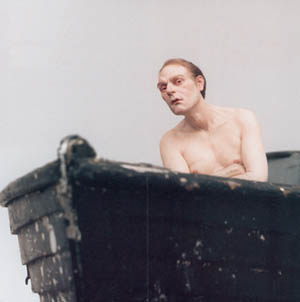
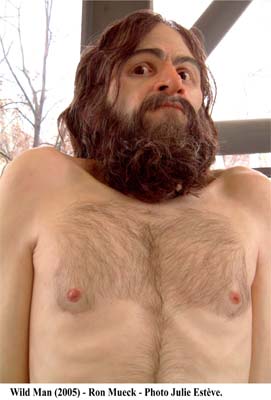
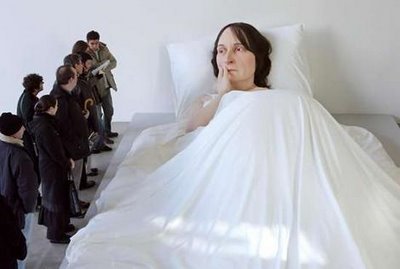
Fortunately this late summer blockbuster was held over for an additional week and I didn’t miss out this time. Anyone that remembers Jim Henson’s ‘Muppets’ or the film ‘Labyrinth’ will have an immediate fondness for Mueck’s more recent creations. The hyper-realist sculptor has made a very successful transition from the world of movie and advertising animatronics to the spotlight of contemporary art. As part of the unforgettable exhibition ‘Sensation: Young British Artists from the Saatchi Collection’ that sparked controversy on three separate continents, Mueck has taken the attention he received for his small part in that show and made himself over as a main attraction. While many super star careers arose in the wake of ‘Sensation,’ this recent showcase reveals what could very well be Mueck’s greatest attempt so far at recruiting a new audience for contemporary art. Before we draw conclusions on the significance of this show, let’s consider the work.
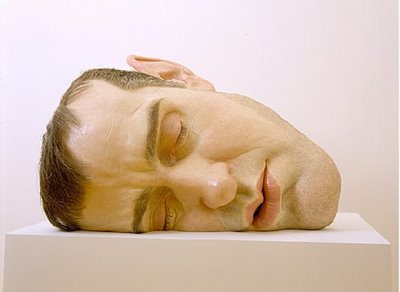

While even the most uninitiated spectator can appreciate Mueck’s arduous quest for a pristine naturalism—this patience for representational technique remains thoroughly praiseworthy indeed, many commentators remark extensively on the careful selections that dictate the scale of these works. In my estimation, however, scale merely permits the viewer an otherwise impossible perspective, whether it be seeing that big or this small. I happen to think that Mueck simply takes his audience by the hand to a better vantage point. The more important aspect, however, is the actual site to behold.
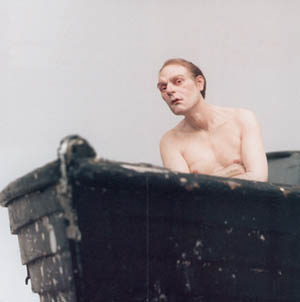
His subject matter is at once both exotic and mundane. These models could be found in the everyday if one knew exactly where to look. While these forms are not too alien to our everyday experience, what seems almost other-worldly is Mueck’s choices in posing these creatures. Rather than the idealized forms of ancient or classical sculpture, the artist has isolated and solidified the most chance appearances, looks that punctuate the visual landscape of our experience of others. These are the sort of expressions that you can miss in the real world with a mere glance or blink. They are the looks we would never model.
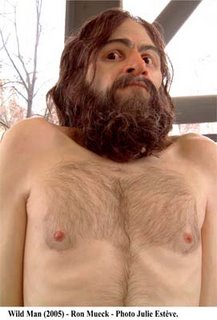
Contrary to much of the commentary provided in the museum by the show’s organizers, the eerie candour of this work should not be interpreted too plainly or directly. While these forms are very far from idealized, they are quite recognizable. We have seen many of these expressions before… dissatisfaction, fear and frailty. They can’t hide insecurity or inadequacy any better than we.

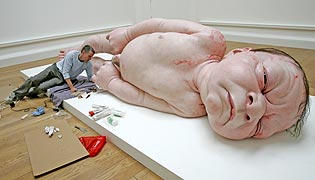
Interestingly, I found myself and those around me seemingly unable to relate to these sculptures. I know that because it seemed so natural to attempt an empathy for what we saw. I suppose that if we struggle to regard someone appearing desperate on the street we have no hope of feeling compassion for a shrunken or enlarged silicon copy in a museum. Could Mueck’s works speak beyond our spellbound voyeurism to a deeper sense, the feeling of isolation that we all experience a little bit each day? Hopefully, this vast new audience will pause in examining the subtle connections of hair and tissue and the life-like pores on Mueck’s models long enough to consider the thought. As long as most museum visitors prefer twenty foot newborns to a severed cow’s head or a shark in formaldehyde, however, it remains unlikely.
26.9.06

quotes... Christian Aesthetics

Due to the recent and worthwhile discussion generated by the last entry, I thought it would be a good idea to give a sample of the work of one evangelical philosopher/theologian who has contributed immensely to the conversation about defining art. Consider these thoughts:


There is no purpose which art serves, not any which it is intended to serve. Art plays and is meant to play an enormous diversity of roles in human life. Works of art are instruments by which we perform such diverse actions as praising our great mean and expressing our grief, evoking emotion and communicating knowledge. Works of art are objects of such actions as contemplation for the sake of delight. Works of art are accompaniments for such actions as hoeing cotton and rocking infants. Works of art are background for such actions as eating meals and walking through airports… The purposes of art are the purposes of life.

Nicholas Wolterstorff, Art in Action, 4

and...

Surely it is time for us to break out, to start over, to somehow find a way of approaching art which no longer focuses successively on artist and work and receiver, but instead holds all these in view simultaneously, and does so in such a way as to answer the call, now increasingly heard, to take account of the social embeddedness of whichever of these one has in the center of one’s attention: artist, work, receiver. I suggest that we approach art from the angle of the social practices of art.

Nicholas Wolterstorff, “Philosophy of Art After Analysis and Romanticism,” 158.