In the first day of a two day auction at Sotheby's in London, Damien Hirst has already outdone himself. Not only does his little experiment - bypassing the gallery system and going straight to auction with new work - seem a huge success, but he has managed to exceed the already high estimate of $112 million by securing $127.2 million. All this success is achieved in spite of world stock markets reeling from a really bad day yesterday. The auction closes this afternoon, but where will it all stop???
BEAUTIFUL INSIDE MY HEAD FOREVER Sept. 2008 Sotheby's London
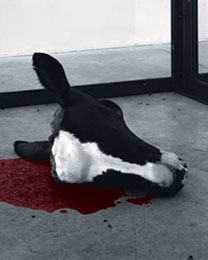
Just when you thought that Hirst couldn't up the stakes on a human skull covered in approximately 8,000 flawless diamonds, here he comes again... with The Golden Calf, the truly monumental centrepiece of a new collection of formaldehyde works. Hirst's magnificent show from last summer - "Beyond Belief" created all kinds of new expectations and opportunities for contemporary art, but his recent decision to take a collection of work straight to the auction house (completely by-passing the established gallery system that has handled the sale of artworks for more than century now) has many pundits up in arms. The jury is still out on whether or not Hirst can pull this off. He stands to make, by most accounts, upwards of £65 million. We'll find out if his evil plan actually works in just a couple monthes. Sotheby's is holding the auction and providing unprecedented arrangements for the collection. (Details here.)
In the meantime, we can listen to the critics make their predictions and oogle over some of the most bizarre specimens of his practice to date.
View some fantastic images from the collection. ReadMaev Kennedy's "Golden calf, bull's heart, a new shark: Hirst's latest works may fetch £65m... Artist bypasses galleries and dealers to go straight to Sotheby's auction". from THE GUARDIAN
Read Roger Bevan's "Damien Hirst is Rewriting the Rules of the Market, Part I". Read Sarah Thornton's "Damien Hirst is Rewriting the Rules of the Market, Part II". both from THE ART NEWSPAPER
Damien Hirst 'Beyond Belief' White Cube, London 3 June - 7 July, 2007
What more can be said about this recent exhibition? Especially the sparkling highlight of the show For the Love of God, Hirst's diamond encrusted, platinum encased human skull?
8,601 VVS to flawless diamonds...
1,106.18 carats in total weight...
In the UK, 2nd in value to the Crown Jewels...
I have to say that the piece is truly stunning and well worth all the hype and media attention it has garnered. Hirst's skull is probably the most remarkable accomplishment of contemporary art. Not to detract from Smithson's Spiral Jetty or Barney's Cremaster Cycle, but this most recent product by Hirst must be the most significant piece of contemporary art to date. Let me qualify that grand compliment.
I am a committed fan of Hirst's work and have an abiding appreciation for the lineage of his practice, especially the earliest works, but I, like others no doubt, have observed a serious decline in the quality of his recent productions. It is almost too obvious to say that Hirst's art has become an international brand, more high class commodity than avant-garde creation, but maybe it should be stated clearly once more. The once refreshingly wry and unrefined sentiments about life’s temporality and death’s perpetual villainy in the form of over-the-top sculptures involving the animal carcasses and life cycles and installations of medical magic have come to possess maybe the greatest monetary value of any art works around but little meaning in the face of their ongoing reproduction. We are beginning to see that we must now take Hirst at his word when he seems to feign that it’s all about the cash.
Despite the glitzy haze surrounding this recent work and the fact that the rest of the exhibition resembles a formulaic museum retrospective and not a very interesting slice of new work, the sheer potency of Hirst’s skull cannot be dismissed. I think the skull will be remembered as his crowning achievement (pun intended!) for the simple fact that it has accomplished his highest aims for art and at the same time embodied consistently the spirit of all his overall body of work.
One of the more attractive features of Hirst’s legacy has been the irrepressible attitude of the common man at work within his practice. Due in no small part to his rather rough, working-class upbringing in Leeds, Hirst brings a simple, often crass perspective to bear on the makings and meanings of contemporary art. None too subtle, he bashes the often vain sophistication of the art world with a deep interest in art that surprises its audience and confronts real life.
With a persistent concentration on the imagery of death, Hirst has pushed aesthetic debates about what can be considered ‘art’ and at the same time leveled biting cultural critiques at the broader society and its specific attempts to escape the realities of death. In this way, he has made name for himself that rivals many international trademarks. Basically, I think that Hirst’s work constitutes a modern appropriation of an interesting and explicitly Christian format from art history—the memento mori. This Latin phrase means ‘Remember that you will die’ and represents a body of art that involves specific symbols of life’s fleeting condition (e.g. flowers, hourglasses, and skulls!) in a tradition of handsomely crafted genre paintings. With this framework, I see three important or overriding categories of death imagery: natural death (i.e. the animals and life cycles), the clinical aesthetic (e.g. the Pharmacy installation), and the death of painting (i.e. the butterfly mosaics, spot and spin paintings).
In this way, Hirst employs the aesthetic of minimalism and a tongue-in-cheek appreciation for the commodity fetish of late capitalism (a posture he learned from Jeff Koons’ philosophy of art as ‘the best that money can buy’) in the service of grand gestures about the most common and elemental features of the human experience: birth, sex and death to name the central core. Thus, For the Love of God must be the natural apex of this sort of practice, for, as the artist himself explains, what could be a grander gesture in the resistance of death than a diamond-encrusted skull smiling back at you?
But of course, the importance of this work does not rest merely on the qualities of the aesthetic object. The fact of the matter, however, is that the atmosphere of pomp and circumstance surrounding the work cannot be explained through the customary language of experiencing art that informs the common fare of art criticism today. As one who has seen the piece, I can say that the experience of viewing the work rehearses the strictures of a medieval pilgrimage to see a holy relic and resembles very little the casual strolls through contemporary museums we usually take. Indeed, the act of assembling with other worshippers outside the gallery and then journeying through the gallery to the dark room where one finally gains that private audience with the skull must awaken latent spiritual sensations in anyone who has ever visited the ruins of an ancient temple or a historic cathedral. For many, the experience of Hirst’s skull may be the most religious event of their lives or the closest to the traditional structure of an officially religious sort of worship.
As Jerry Saltz has pointed out so well, Hirst’s attention to death imagery is devoted to a bold affirmation of life. At the risk of neglecting the complexities of nuance and ambivalence so highly regard by the art world, Hirst intends his work to send audiences home thinking about their own lives and the certain death that awaits us all. So, I happily join the ranks of the worshippers in enjoying the sly irony of the skull, and after all the fun of seeing it, I marvel even more at the gesture represented by the work. Anytime I can get my education about a piece of art from the confident and engaged musings of a security guard, I’m happy. In providing the impetus for so much essential outsider interaction with a piece of contemporary art (i.e. security details around the work, unprecedented media coverage and basically making a gallery show a broadly relevant and entertaining cultural event), Hirst has popped the bubble of art world exclusivity for a moment; hopefully just long enough for an inquisitive elect out of all the uninitiated masses to find something to latch onto inside the discourse and maybe an opportunity consider some important questions in a fresh way. That sort of prospect I can’t resist.
View a brief overview of the show and an interview with the artist here.
Also, check out another interesting interview from a few years ago at a major retrospective in Naples, Italy. See below.
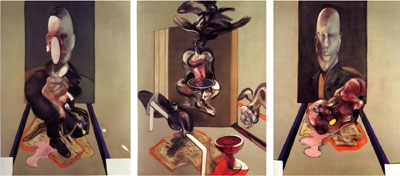
Interestingly, the Gagosian Gallery’s press release for this dual exhibition carefully points out that in the work of Francis Bacon the artist’s preoccupation with the form of the triptych did not arise from the religious roots of the form, but rather was inspired by the panoramic qualities of the cinema screen. In other words, another traditional religious form is given new life by virtue of modern perspectives seeing a greater depth of meaning in the everyday.
In many ways, the triptych’s form derives its potency not from historically appropriate content but, I would argue, from its unique structure. Three in one has always been a powerful formula. In this way, each individual component simultaneously sets itself apart and draws closer to its companion pieces. The result is an inevitable and attractive tension, which often pulls the viewer into the struggle. In these works by Bacon and Hirst, the formula has been shockingly realized. Brandishing the full effect of this unity within diversity, both artists impose their respective gravitational forces upon the viewer.
The multitude of Bacon’s paintings brought together for this show submerges the viewer under the weight of his emotive rage. His grotesque fascination with the mutilation of beautiful form burdens the work with countless echoes of existential doubt and longing. Maybe he has represented well the harsh emotional realities of the portrait’s subject or the artist himself, but in this way, the very choice of painting, not to mention the texture and style of the medium, merely adds to the larger prostitution of hope within his artistic vision. Ultimately, he does not capture the agony he longs to exhibit but leaves his viewer with a glimpse of the sheer horror within, a horror that cannot find a way out. Looming just beyond the edges of Bacon’s work, death waits with a patience that confounds the horror of life. If Bacon attempts to map the meaninglessness within the heart, Hirst merely pulls back the curtain shielding each life from its grim future. In this way, Hirst shares a great deal with Bacon while at the same time resolving the progression his paintings began.
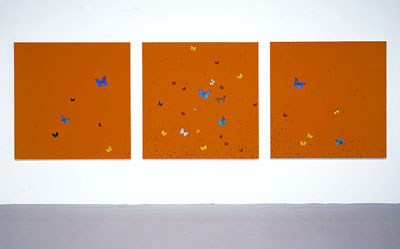
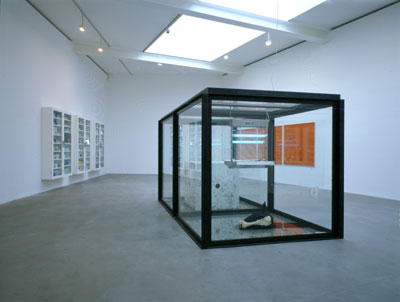
The trajectory of Bacon's work has reached its terminal velocity in the clinical austerity of Hirst’s call to death. In contrast to the anatomical interest generated by Gunther von Hagens’ Body Worlds exhibitions, Hirst’s work presents through a characteristically cynical and somber lens life dissected and dismembered. Even the black monochrome triptych Forgive Me Father for I Have Sinned, 2006 captures cleverly the artist’s penchant for interrupting the viewer’s aesthetic experience with subtle reminders of the inevitable. Besides the Bosch-like texture of the triptych’s rough surface, the work preserves the unnerving smell of death beneath the layers of flies mixed in resin. In this way, this work and others incorporate a satire of the mundane into the larger scope of Hirst’s picture of death. With Like Flies Brushed off a Wall We Fall, 2006, Hirst offers his viewer the closest thing to a pretty aesthetic object that may be found in his body of work. Despite the minimalist appeal of the paintings, the viewer cannot ignore the satirical effect rendered by his choice of materials: household gloss, common butterflies and flies. Nothing signifies this mutually clinical and mundane aesthetic better than the early milestone of Hirst’s career A Thousand Years, 1990. For Hirst, death no longer looms just beyond the scope of art; it has taken centre stage.
More than a timely polemic against the pharmaceutical industry or contemporary society’s obsession with medicine, this work contains significant implications for the theologically minded. Despite the grim nature of its presentation, the sentiment is religious at its core. Humanity cannot evade it own eventuality and therefore must face it. Religion is nothing if not a means to that goal, but how hard we work to forget ourselves and our own frailty. In this way, Hirst’s greatest achievement might be the symbolic space he has created between the public’s guilty fascination with his work and their unwitting attempt to distance themselves from its latent reality.
 In the first day of a two day auction at Sotheby's in London, Damien Hirst has already outdone himself. Not only does his little experiment - bypassing the gallery system and going straight to auction with new work - seem a huge success, but he has managed to exceed the already high estimate of $112 million by securing $127.2 million. All this success is achieved in spite of world stock markets reeling from a really bad day yesterday. The auction closes this afternoon, but where will it all stop???