Showing posts with label contemporary art. Show all posts
Showing posts with label contemporary art. Show all posts
8.1.09
Nicolas Bourriaud's 'Altermodern' Manifesto
The 2009 Tate Triennial promises to be one of the most significant moments in the recent history of art.

24.12.08
SF MOMA: The Art of Participation

San Francisco Museum of Modern Art
8 November, 2008 - 8 February, 2009
8 November, 2008 - 8 February, 2009
It seems the art world has finally seen its first museum scale exhibition devoted entirely to relational art. A marginalized discourse no more?
Exhibition description:
"Looking back nearly 60 years across a wide spectrum of genres and media, this exhibition examines how artists have engaged members of the public as essential collaborators in the art-making process. Works by more than 40 artists will be on view, from early performance and conceptual pieces by such pioneers as John Cage, Lygia Clark, Dan Graham, and Hans Haacke to contemporary projects by Jochen Gerz, Felix Gonzalez-Torres, Lynn Hershman Leeson, and Erwin Wurm, among others. Encompassing restagings of historic installations as well as new commissions that invite your direct participation, the exhibition will change in form and content as you and other visitors contribute — either at the museum or online."
View... and participate in online works of art in the exhibition here.
Take part in the online discussion of the exhibition on the SF MOMA blog.
Visit while you can!
 Participating Artists:
Abramović/Ulay
Vito Acconci
Francis Alÿs
John Baldessari
Joseph Beuys
Blank & Jeron and Gerrit Gohlke
George Brecht
Jonah Brucker-Cohen and Mike Bennett
John Cage
c a l c and Johannes Gees
Janet Cardiff
Lygia Clark
Minerva Cuevas
Maria Eichhorn
VALIE EXPORT
Harrell Fletcher and Jon Rubin
Fluxus Collective
Kit Galloway and Sherrie Rabinowitz
Jochen Gerz
Matthias Gommel
Felix Gonzalez-Torres
Dan Graham
Hans Haacke
Hans Haacke
Lynn Hershman Leeson
Allan Kaprow
Henning Lohner and Van Carlson
Chip Lord, Curtis Schreier, and Bruce Tomb
Rafael Lozano-Hemmer
Tom Marioni
MTAA (M.River and T.Whid Art Associates)
Antoni Muntadas
Yoko Ono
Nam June Paik
Dan Phiffer and Mushon Zer-Aviv
Raqs Media Collective
Robert Rauschenberg
Warren Sack
Mieko Shiomi
Torolab
Wolf Vostell
Andy Warhol
Stephen Willats
Erwin Wurm
30.7.08
Damien Hirst update...
BEAUTIFUL INSIDE MY HEAD FOREVER
Sept. 2008
Sotheby's London

Sept. 2008
Sotheby's London

Just when you thought that Hirst couldn't up the stakes on a human skull covered in approximately 8,000 flawless diamonds, here he comes again... with The Golden Calf, the truly monumental centrepiece of a new collection of formaldehyde works. Hirst's magnificent show from last summer - "Beyond Belief" created all kinds of new expectations and opportunities for contemporary art, but his recent decision to take a collection of work straight to the auction house (completely by-passing the established gallery system that has handled the sale of artworks for more than century now) has many pundits up in arms. The jury is still out on whether or not Hirst can pull this off. He stands to make, by most accounts, upwards of £65 million. We'll find out if his evil plan actually works in just a couple monthes. Sotheby's is holding the auction and providing unprecedented arrangements for the collection. (Details here.)
In the meantime, we can listen to the critics make their predictions and oogle over some of the most bizarre specimens of his practice to date.
View some fantastic images from the collection.
Read Maev Kennedy's "Golden calf, bull's heart, a new shark: Hirst's latest works may fetch £65m... Artist bypasses galleries and dealers to go straight to Sotheby's auction".
from THE GUARDIAN
Read Roger Bevan's "Damien Hirst is Rewriting the Rules of the Market, Part I".
Read Sarah Thornton's "Damien Hirst is Rewriting the Rules of the Market, Part II".
both from THE ART NEWSPAPER
Damien Hirst's OTHER CRITERIA

In the meantime, we can listen to the critics make their predictions and oogle over some of the most bizarre specimens of his practice to date.
View some fantastic images from the collection.
Read Maev Kennedy's "Golden calf, bull's heart, a new shark: Hirst's latest works may fetch £65m... Artist bypasses galleries and dealers to go straight to Sotheby's auction".
from THE GUARDIAN
Read Roger Bevan's "Damien Hirst is Rewriting the Rules of the Market, Part I".
Read Sarah Thornton's "Damien Hirst is Rewriting the Rules of the Market, Part II".
both from THE ART NEWSPAPER
Damien Hirst's OTHER CRITERIA
13.4.07
art... "Re-Enchantment"
 The Art Seminar Roundtable
organized and chaired by
James Elkins
E. C. Chadbourne Professor of Art History, Theory, and Criticism
School of the Art Institute of Chicago
Event Abstract:
One of the most difficult questions in contemporary art and art history is the place of religion and spirituality. Gestures of transcendence are ubiquitous, but they are seldom admitted into serious discourse on art unless the work is critical or religion. Artists who embrace various forms of private spirituality can find places in the art world (eg, Bill Viola, Wolfgang Laib), but those who represent the principal organized religions normally can’t. The gap between artists and critics who talk openly about spirituality or religion, and academic writers who eschew it, is enormous. Meanwhile art history is theorizing transcendence in very interesting ways.
Schedule:
Monday, April 16, 2007; SAIC Auditorium, Columbus Building, 6pm
Why Religion and Contemporary Art are Incompatible, James Elkins, SAIC
Tuesday, April 17, 2007; SAIC Ballroom, Maclean Center, 112 S. Michigan Ave, 10am-4pm
Roundtable: 'Re-Enchantment'
Panelists and Readings:
Gregg Bordowitz, School of the Art Institute of Chicago
"Abstract for You"
"My Postmodernism"
Thierry de Duve, University of Lille-III
"Come on, humans, one more effort if you want to be post-Christians!"
"Mary Warhol/Joseph Duchamp"
Wendy Doniger, University of Chicago
"The Impermanence of Art"
James Elkins, School of the Art Institute of Chicago
"Ch. 4, On the Strange Place of Religion in Contemporary Art"
"Ch. 5, On the Strange Place of Religion in Contemporary Art"
"Ch. 7, On the Strange Place of Religion in Contemporary Art"
Boris Groys, Academy for Design Karlsruhe, Germany
"Religion as Medium"
Kajri Jain, University of Western Ontario
"from the Conclusion to Gods in the Bazaar"
Tomoko Masuzawa, University of Michigan
"intro from The Invention of World Religions"
"Troubles with Materiality: The Ghost of Fetishism in the Nineteenth Century"
"Return of the What?--or Why Should We Care About the (Mere) Concept of Religion"
David Morgan, Valparaiso University
"Interview with Meg Cranston, co-curator of '100 Artists See God'"
"'100 Artists See God' Exhibition Review"
Taylor Worley, PhD candidate Durham University
"Reparations and Conversations: A Future for Contemporary Art in Theological Reflection"
Brief Review:
Due to the great diversity of research represented by the scholars on the panel, much of the conversation on "Re-Enchantment" centered on essential questions of defining the terms of the debate: contested items such as 'religion', 'belief' and 'faith'. Driven by the antipathies between Western and non-Western perspectives, these issues were not quickly resolved but left hanging around in the interest of discussing art practice more specifically. Appropriating metaphors like 'camouflage' or 'smuggling' for understanding how religion creeps into art practice, the panel debated hotly the intentions or motivations behind artists that allow their work to have a religious or spiritual quality. Apparently, the great suspicion of religion demonstrated by Tim Clark (with his oft-quoted statement: "I will have nothing to do with that Leftist, self-satisfied clap trap about art 'as substitute religion.'") runs deeper than most of us thought. Why is it so difficult to state clearly modernism's opposition to traditional religion and postmodernism's suspicion of 'true believers'? Maybe the contentiousness of the panel over the terms employed represents the true starting point for understanding that the age we live in prizes no one perspective over the other and that the result for art criticism or art history is that there is no authoritative power to keep religion either within or beyond the pale. Most helpful was David Morgan's discussion of different 'ways of seeing,' and hopefully his insights will be further developed and allowed to offer guidance in this subject. With the text of the transcript now in the hands of the participants, we can all look forward to a more focused conversation finding its way into the pages of the book. Details on the publication will be forthcoming.
11.3.07
art... Tino Sehgal

Tino Seghal
This Success or This Failure
Institute of Contemporary Art, London
29 January - 4 March 2007
Pushing open the large, heavy door to the main gallery I see ten or so children of various ages and one adult dispersed throughout the room. Amid the stark white walls of the gallery and the bare concrete floor, the pulsing shapes of children at play begin to animate the space and dispel its visual emptiness. Besides the occasional effervescent peep or giggle, the hushed mood of the room seems at once disturbed by my obvious intrusion, but I soon learn that the game at hand is Sleeping Lions, a game that depends upon a certain attempt at quiet. Out of instinct I approach the adult, but she seems disinterested by my presence. The children, however, are only too inviting. In the short time since my intrusion, the children seem to have identified a winner, and its time for a new game to begin.
Alright, time for an abrupt change. The new game will be Sleeping Bears instead of Sleeping Lions; both involve the same rules but yield a contrast undecipherable to anyone unable to distinguish the roar of a lion from the roar of a bear. My focused study of the group has generated curiosity among my subjects. They perceive my smile as a subtle request to join them. I am only too willing.
Like the other participants, I lie down on the bare concrete and silently await the hunters. With eyes closed, I listen for the other bears to be awoken by the stealthy hunters as they stalk and startle their prey. Peeking only occasionally to assure myself that I am not the only participant left alone on the floor, I wait to receive the due attention of the hunters. Before long, footsteps creep toward me and the ferocious growl of a child comes down upon me. Elated, I open my eyes to stare face to face with a giddy, smiling seven year old boy. He has played well his part in this game, and I am only too happy to be his prey.
For only a moment, my elation is pure and tangible. Not only am I accepted and included, but I have played an integral role in the joy of others. My participation has added something wholly unique to the moment. The game is a better one for my involvement in it, of this I am at once quite certain.
As I rise from my sleeping posture, I notice the walls of the gallery lined with several more adults, just watching and observing the random play before them. They have crept in unnoticed and remained beyond the boundaries of our game. They sit with blank expressions on their faces and exude a sense of disappointment.
This success or this failure.
Soon a fresh group of children arrives in the room, and those I have played with are gone for a break. I am not surprised to learn that the artwork consists only within this gallery. Like the experience of most of Sehgal's work, I exit with more questions than answers.
Let me say very clearly to the skeptical: this piece is not an experiment. But rather, it was a moment, a completely unrepeatable opportunity. Sehgal has offered each visitor either the chance to redeem a small interval of time or the invitation to lose another moment to distant observation.
Fortunately for us, the general ambiguity of his work and the lack of dictated instruction allows each visitor to internalize the opportunity for maximum effect. Without a prescription for success in this interpersonal puzzle, each person must confront their own fears and anxieties in order to learn what they wish to gain or lose from each experience. Sehgal has placed this type of moment under the microscope of careful reflection by constructing these authentic encounters in the gallery. They feel so real because they are, and they are real so that they might have an actual effect on one's daily life.
How many opportunities like these fill our days without us ever engaging them with such introspection? I would guess quite a few of these moments pass us by each day. Most of us have never taken a moment to consider just how isolated we are as individuals in today's complex web of social specialization. Where is the meaningful contact that we all long for? Could it be just beyond the bubble of one's own perceptions of isolation, alienation and loneliness?
To redeem these moments for all the good that God has hidden within them, one must venture a great risk. I must wager my own vulnerability against the potential effects (both positive and negative) of interaction. What is the good news of Jesus' restoration and reconciliation of sinners to God and to one anther if not a promise of hope for such free and honest exchanges? It has taken the giddy smiles of young faces in Sehgal's relational space to help me recall this great truth; no doubt a providential gift to a father awaiting the arrival of his first child.
In this way, perhaps, Sehgal's This Success or This Failure is a poignant emblem of the choice embedded within the contemporary challenges of engaging art. We all want a meaningful experience of art, but how many of us are willing to extend the personal wager it might require to ensure such an experience? It seems that the climate of contemporary art refuses to accommodate the social specializations that sustain our comfortable isolations, and therefore we may need to adjust our own modes of perception and engagement to find a way through.
This problem or this possibility...
Alright, time for an abrupt change. The new game will be Sleeping Bears instead of Sleeping Lions; both involve the same rules but yield a contrast undecipherable to anyone unable to distinguish the roar of a lion from the roar of a bear. My focused study of the group has generated curiosity among my subjects. They perceive my smile as a subtle request to join them. I am only too willing.
Like the other participants, I lie down on the bare concrete and silently await the hunters. With eyes closed, I listen for the other bears to be awoken by the stealthy hunters as they stalk and startle their prey. Peeking only occasionally to assure myself that I am not the only participant left alone on the floor, I wait to receive the due attention of the hunters. Before long, footsteps creep toward me and the ferocious growl of a child comes down upon me. Elated, I open my eyes to stare face to face with a giddy, smiling seven year old boy. He has played well his part in this game, and I am only too happy to be his prey.
For only a moment, my elation is pure and tangible. Not only am I accepted and included, but I have played an integral role in the joy of others. My participation has added something wholly unique to the moment. The game is a better one for my involvement in it, of this I am at once quite certain.
As I rise from my sleeping posture, I notice the walls of the gallery lined with several more adults, just watching and observing the random play before them. They have crept in unnoticed and remained beyond the boundaries of our game. They sit with blank expressions on their faces and exude a sense of disappointment.
This success or this failure.
Soon a fresh group of children arrives in the room, and those I have played with are gone for a break. I am not surprised to learn that the artwork consists only within this gallery. Like the experience of most of Sehgal's work, I exit with more questions than answers.
Let me say very clearly to the skeptical: this piece is not an experiment. But rather, it was a moment, a completely unrepeatable opportunity. Sehgal has offered each visitor either the chance to redeem a small interval of time or the invitation to lose another moment to distant observation.
Fortunately for us, the general ambiguity of his work and the lack of dictated instruction allows each visitor to internalize the opportunity for maximum effect. Without a prescription for success in this interpersonal puzzle, each person must confront their own fears and anxieties in order to learn what they wish to gain or lose from each experience. Sehgal has placed this type of moment under the microscope of careful reflection by constructing these authentic encounters in the gallery. They feel so real because they are, and they are real so that they might have an actual effect on one's daily life.
How many opportunities like these fill our days without us ever engaging them with such introspection? I would guess quite a few of these moments pass us by each day. Most of us have never taken a moment to consider just how isolated we are as individuals in today's complex web of social specialization. Where is the meaningful contact that we all long for? Could it be just beyond the bubble of one's own perceptions of isolation, alienation and loneliness?
To redeem these moments for all the good that God has hidden within them, one must venture a great risk. I must wager my own vulnerability against the potential effects (both positive and negative) of interaction. What is the good news of Jesus' restoration and reconciliation of sinners to God and to one anther if not a promise of hope for such free and honest exchanges? It has taken the giddy smiles of young faces in Sehgal's relational space to help me recall this great truth; no doubt a providential gift to a father awaiting the arrival of his first child.
In this way, perhaps, Sehgal's This Success or This Failure is a poignant emblem of the choice embedded within the contemporary challenges of engaging art. We all want a meaningful experience of art, but how many of us are willing to extend the personal wager it might require to ensure such an experience? It seems that the climate of contemporary art refuses to accommodate the social specializations that sustain our comfortable isolations, and therefore we may need to adjust our own modes of perception and engagement to find a way through.
This problem or this possibility...
14.8.06
art... Francis Bacon and Damien Hirst
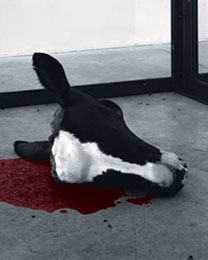
Triptychs:
GagosianGallery______________________________________________
Britannia Street, London
20 June – 4 August
20 June – 4 August
Interestingly, the Gagosian Gallery’s press release for this dual exhibition carefully points out that in the work of Francis Bacon the artist’s preoccupation with the form of the triptych did not arise from the religious roots of the form, but rather was inspired by the panoramic qualities of the cinema screen. In other words, another traditional religious form is given new life by virtue of modern perspectives seeing a greater depth of meaning in the everyday.
In many ways, the triptych’s form derives its potency not from historically appropriate content but, I would argue, from its unique structure. Three in one has always been a powerful formula. In this way, each individual component simultaneously sets itself apart and draws closer to its companion pieces. The result is an inevitable and attractive tension, which often pulls the viewer into the struggle. In these works by Bacon and Hirst, the formula has been shockingly realized. Brandishing the full effect of this unity within diversity, both artists impose their respective gravitational forces upon the viewer.
In many ways, the triptych’s form derives its potency not from historically appropriate content but, I would argue, from its unique structure. Three in one has always been a powerful formula. In this way, each individual component simultaneously sets itself apart and draws closer to its companion pieces. The result is an inevitable and attractive tension, which often pulls the viewer into the struggle. In these works by Bacon and Hirst, the formula has been shockingly realized. Brandishing the full effect of this unity within diversity, both artists impose their respective gravitational forces upon the viewer.
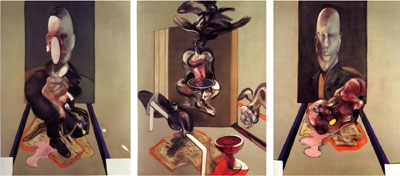
The multitude of Bacon’s paintings brought together for this show submerges the viewer under the weight of his emotive rage. His grotesque fascination with the mutilation of beautiful form burdens the work with countless echoes of existential doubt and longing. Maybe he has represented well the harsh emotional realities of the portrait’s subject or the artist himself, but in this way, the very choice of painting, not to mention the texture and style of the medium, merely adds to the larger prostitution of hope within his artistic vision. Ultimately, he does not capture the agony he longs to exhibit but leaves his viewer with a glimpse of the sheer horror within, a horror that cannot find a way out. Looming just beyond the edges of Bacon’s work, death waits with a patience that confounds the horror of life. If Bacon attempts to map the meaninglessness within the heart, Hirst merely pulls back the curtain shielding each life from its grim future. In this way, Hirst shares a great deal with Bacon while at the same time resolving the progression his paintings began.
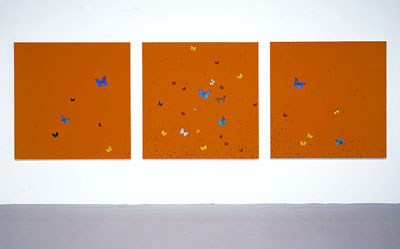
The trajectory of Bacon's work has reached its terminal velocity in the clinical austerity of Hirst’s call to death. In contrast to the anatomical interest generated by Gunther von Hagens’ Body Worlds exhibitions, Hirst’s work presents through a characteristically cynical and somber lens life dissected and dismembered. Even the black monochrome triptych Forgive Me Father for I Have Sinned, 2006 captures cleverly the artist’s penchant for interrupting the viewer’s aesthetic experience with subtle reminders of the inevitable. Besides the Bosch-like texture of the triptych’s rough surface, the work preserves the unnerving smell of death beneath the layers of flies mixed in resin. In this way, this work and others incorporate a satire of the mundane into the larger scope of Hirst’s picture of death. With Like Flies Brushed off a Wall We Fall, 2006, Hirst offers his viewer the closest thing to a pretty aesthetic object that may be found in his body of work. Despite the minimalist appeal of the paintings, the viewer cannot ignore the satirical effect rendered by his choice of materials: household gloss, common butterflies and flies. Nothing signifies this mutually clinical and mundane aesthetic better than the early milestone of Hirst’s career A Thousand Years, 1990. For Hirst, death no longer looms just beyond the scope of art; it has taken centre stage.
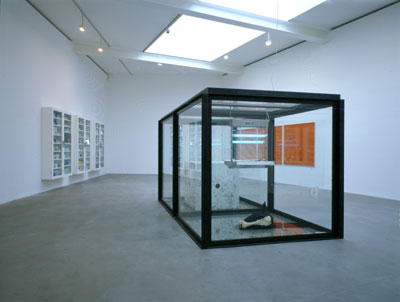
More than a timely polemic against the pharmaceutical industry or contemporary society’s obsession with medicine, this work contains significant implications for the theologically minded. Despite the grim nature of its presentation, the sentiment is religious at its core. Humanity cannot evade it own eventuality and therefore must face it. Religion is nothing if not a means to that goal, but how hard we work to forget ourselves and our own frailty. In this way, Hirst’s greatest achievement might be the symbolic space he has created between the public’s guilty fascination with his work and their unwitting attempt to distance themselves from its latent reality.
Subscribe to:
Posts (Atom)