26.9.06

quotes... Christian Aesthetics

Due to the recent and worthwhile discussion generated by the last entry, I thought it would be a good idea to give a sample of the work of one evangelical philosopher/theologian who has contributed immensely to the conversation about defining art. Consider these thoughts:


There is no purpose which art serves, not any which it is intended to serve. Art plays and is meant to play an enormous diversity of roles in human life. Works of art are instruments by which we perform such diverse actions as praising our great mean and expressing our grief, evoking emotion and communicating knowledge. Works of art are objects of such actions as contemplation for the sake of delight. Works of art are accompaniments for such actions as hoeing cotton and rocking infants. Works of art are background for such actions as eating meals and walking through airports… The purposes of art are the purposes of life.

Nicholas Wolterstorff, Art in Action, 4

and...

Surely it is time for us to break out, to start over, to somehow find a way of approaching art which no longer focuses successively on artist and work and receiver, but instead holds all these in view simultaneously, and does so in such a way as to answer the call, now increasingly heard, to take account of the social embeddedness of whichever of these one has in the center of one’s attention: artist, work, receiver. I suggest that we approach art from the angle of the social practices of art.

Nicholas Wolterstorff, “Philosophy of Art After Analysis and Romanticism,” 158.

5.9.06

music... Derek Webb


Mockingbird by Derek Webb

Sadly, it seems Derek Webb has lost his faith in the power of art.

From all accounts, the progressive trajectory that characterized Webb’s I See Things Upside Down has diverged from its artistic course and instead proceeded toward pure rhetoric. In this way, Mockingbird could have made excellent source material for a series of magazine editorials, commentary for a bible study, or maybe a book of poetry. But it should not have been recorded as an album. How did it all go so wrong for the most promising Christian singer-songwriter of this generation?

Webb has always worn his influences on his sleeve, and that sort of honesty has worked well for him in the past because he chose superior influences. I would recommend that Webb return quickly to his influences, namely Dylan. A secondary viewing of No Direction Home might reveal for him more clearly the genius behind Dylan’s legacy. In a time when the country was torn in two by conflicting opinions of grave political matters, Dylan refused to let his art be subsumed into the prevalent ethos of topical songwriting. It’s the reason that the world will never forget Bob Dylan and never remember Pete Seeger. Dylan launched a legacy in the 60’s while those around him launched campaigns. Ironically, Dylan’s music unquestionably had the greater impact on society and culture. Webb would do well to follow his mentor’s lead in this area.

By any standard, art should show and not teach, dream and not dictate. Not even the best intentions or the truest sentiments can adequately replace the visionary abilities of art. Unfortunately, this is the untold story of kitsch. Usually thought of purely in terms of overly sweet or saccharine sentimentality, kitsch actually has a dark side as well. You see the earnest convictions of Webb’s newest cd are no different than the sappiest CCM love ballad to God because both rely on pre-digested content. Sadly, political credos do little more than Hallmark slogans in the end. Both are easily dismissed for the simple fact that neither evoke wonder and deepen the questions upon revisiting.

Even in truly difficult times, people still want sermons from their preachers and songs from their artists. Art will not change the world on its own, but it must be allowed to do its individual and unique part. If Webb wants the choir to sing so badly, maybe he should stop preaching to them and start modelling for them a better approach to art-making. We don't need another mockingbird.

14.8.06

art... Francis Bacon and Damien Hirst


Triptychs:


GagosianGallery______________________________________________


Britannia Street, London
20 June – 4 August

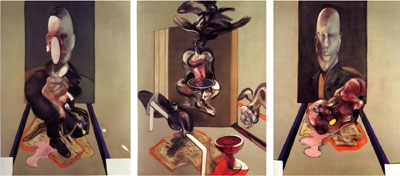
Interestingly, the Gagosian Gallery’s press release for this dual exhibition carefully points out that in the work of Francis Bacon the artist’s preoccupation with the form of the triptych did not arise from the religious roots of the form, but rather was inspired by the panoramic qualities of the cinema screen. In other words, another traditional religious form is given new life by virtue of modern perspectives seeing a greater depth of meaning in the everyday.

In many ways, the triptych’s form derives its potency not from historically appropriate content but, I would argue, from its unique structure. Three in one has always been a powerful formula. In this way, each individual component simultaneously sets itself apart and draws closer to its companion pieces. The result is an inevitable and attractive tension, which often pulls the viewer into the struggle. In these works by Bacon and Hirst, the formula has been shockingly realized. Brandishing the full effect of this unity within diversity, both artists impose their respective gravitational forces upon the viewer.


The multitude of Bacon’s paintings brought together for this show submerges the viewer under the weight of his emotive rage. His grotesque fascination with the mutilation of beautiful form burdens the work with countless echoes of existential doubt and longing. Maybe he has represented well the harsh emotional realities of the portrait’s subject or the artist himself, but in this way, the very choice of painting, not to mention the texture and style of the medium, merely adds to the larger prostitution of hope within his artistic vision. Ultimately, he does not capture the agony he longs to exhibit but leaves his viewer with a glimpse of the sheer horror within, a horror that cannot find a way out. Looming just beyond the edges of Bacon’s work, death waits with a patience that confounds the horror of life. If Bacon attempts to map the meaninglessness within the heart, Hirst merely pulls back the curtain shielding each life from its grim future. In this way, Hirst shares a great deal with Bacon while at the same time resolving the progression his paintings began.


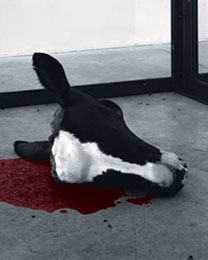
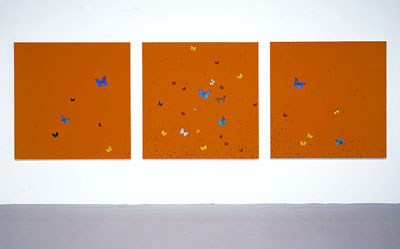
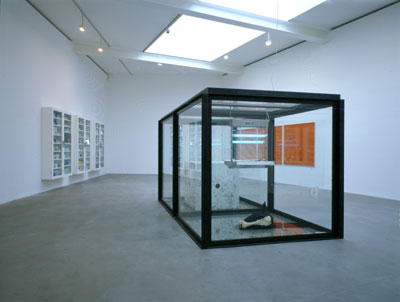
The trajectory of Bacon's work has reached its terminal velocity in the clinical austerity of Hirst’s call to death. In contrast to the anatomical interest generated by Gunther von Hagens’ Body Worlds exhibitions, Hirst’s work presents through a characteristically cynical and somber lens life dissected and dismembered. Even the black monochrome triptych Forgive Me Father for I Have Sinned, 2006 captures cleverly the artist’s penchant for interrupting the viewer’s aesthetic experience with subtle reminders of the inevitable. Besides the Bosch-like texture of the triptych’s rough surface, the work preserves the unnerving smell of death beneath the layers of flies mixed in resin. In this way, this work and others incorporate a satire of the mundane into the larger scope of Hirst’s picture of death. With Like Flies Brushed off a Wall We Fall, 2006, Hirst offers his viewer the closest thing to a pretty aesthetic object that may be found in his body of work. Despite the minimalist appeal of the paintings, the viewer cannot ignore the satirical effect rendered by his choice of materials: household gloss, common butterflies and flies. Nothing signifies this mutually clinical and mundane aesthetic better than the early milestone of Hirst’s career A Thousand Years, 1990. For Hirst, death no longer looms just beyond the scope of art; it has taken centre stage.


More than a timely polemic against the pharmaceutical industry or contemporary society’s obsession with medicine, this work contains significant implications for the theologically minded. Despite the grim nature of its presentation, the sentiment is religious at its core. Humanity cannot evade it own eventuality and therefore must face it. Religion is nothing if not a means to that goal, but how hard we work to forget ourselves and our own frailty. In this way, Hirst’s greatest achievement might be the symbolic space he has created between the public’s guilty fascination with his work and their unwitting attempt to distance themselves from its latent reality.


More Bacon images... more Hirst images

5.7.06

music... Jose Gonzalez

introducing...

josé gonzález

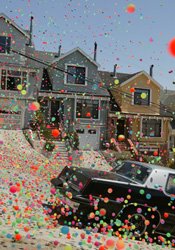
González can boast a truly singular achievementent in the world of contemporary popular music. He is without question both universally recognized and yet utterly nameless. I make that claim based on the fact that multitudes upon multitudes have by now seen the Sony Bravia commercial showcasing the majestic descent of countless, multi-coloured bouncy balls through the banal confines of a random urban landscape. Having glimpsed such a glorious video production, you would also have witnessed the subtly evocative nature of another landscape, the one produced by the vocals and guitar work of José González' "Heartbeats."

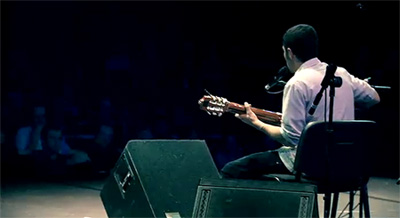
If like me, you were left mesmerized by the at once joyous yet yearning quality of the experience, then you must search on for more. To their credit, Sony represented well their balladeer in the way they masterfully wed their footage with his music, for the balance of pensive and blissful evocations within the video can be found again and again in González' debut album- Veneer and the companion EP - Stay in the Shade.

Along with the remarkable opportunity to be featured in the Sony commercial, González has something else few can claim these days... a unique sound. His rare blend of somber vocal arrangements and complex, Latin-influenced guitar voicings - coupled with the sparse production of the albums, allow for a very fresh reconstruction of the singer/songwriter genre. With such an original strategy, most commentators have to reach back nearly thirty years to find an appropriate comparison in Nick Drake's Pink Moon.

While the extraordinarily reworked covers - Kylie Minogue's "Hand on Your Heart" and the Knife's "Heartbeats," constitute his most powerful tracks, it seems González has all the talent he needs to find a faithful audience, but time will tell if he can gather the experience and mature craftsmanship to keep it. The initial glimmers of his promise definitely shine through on tracks like "Save Your Day," "Lovestain," and "Crosses." If your interest is sufficiently piqued, check out the following links to discover more about the quiet Swede with the nylon string guitar.

one more time... "Heartbeats" Video

29.6.06

quotes... or a word of warning

In retrospect, it seems quite logical that when we as evangelical students of culture began to emerge from the dusky passageways of fundamentalism, our eyes would be dazzled by the enchanting romantic tradition. Because of its skepticism about the relevance of history and the historical process, because of its desire to assign to art a special separate status, and because of its sense of alienation about both unadorned nature and mass culture, romantic theory has offered an appealing sight to those of us whose aesthetic lenses have been ground, whether we appreciate it or not, in the shop of American fundamentalism.

-Roger Lundin,
"Offspring of an Odd Union: Evangelical Attitudes Toward the Arts"
from Marsden's Evangelicalism and Modern America p.144

26.4.06

art... Gestures


gestures...


One of the more debilitating hang-ups that Christian audiences have with both modern and contemporary art stems from a basic misunderstanding of 'artistic gestures.' The preference for gestures in works of art, beginning with the modern era of painting and evolving significantly in contemporary times, represent some unique possibilities for what art can be. Before we explore these remarkable trajectories, let me try and explain the significance of the gesture.

It may prove interesting to pause and consider what comes to mind when we think of a 'gesture.' Maybe you recall a hand signal you received on the highway or something you saw on the street in a foreign country. Perhaps, you remember the way your mother always hugs you when she first receives you. Honestly, we all may have very different associations with the term, but we can't ignore the potential depth beneath such everyday practices.

Merriam-Webster defines a gesture in this way: "a movement usually of the body or limbs that expresses or emphasizes an idea, sentiment, or attitude." It was this sort of abstract, austere definition of a gesture that we find in many famous modern paintings. We can trace the momentous transition in painting that came about possibly during or just after WWII when German or Early Expressionism (Emil Nolde, Franz Marc) gave way to Abstract Expressionism (Willem de Kooning, Jackson Pollock, Barnett Newman, Mark Rothko).
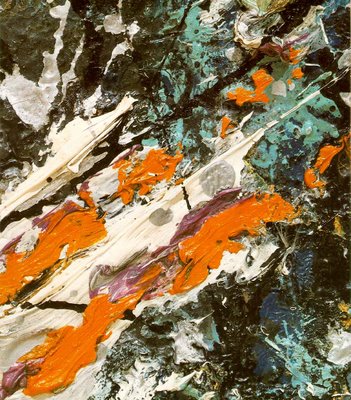

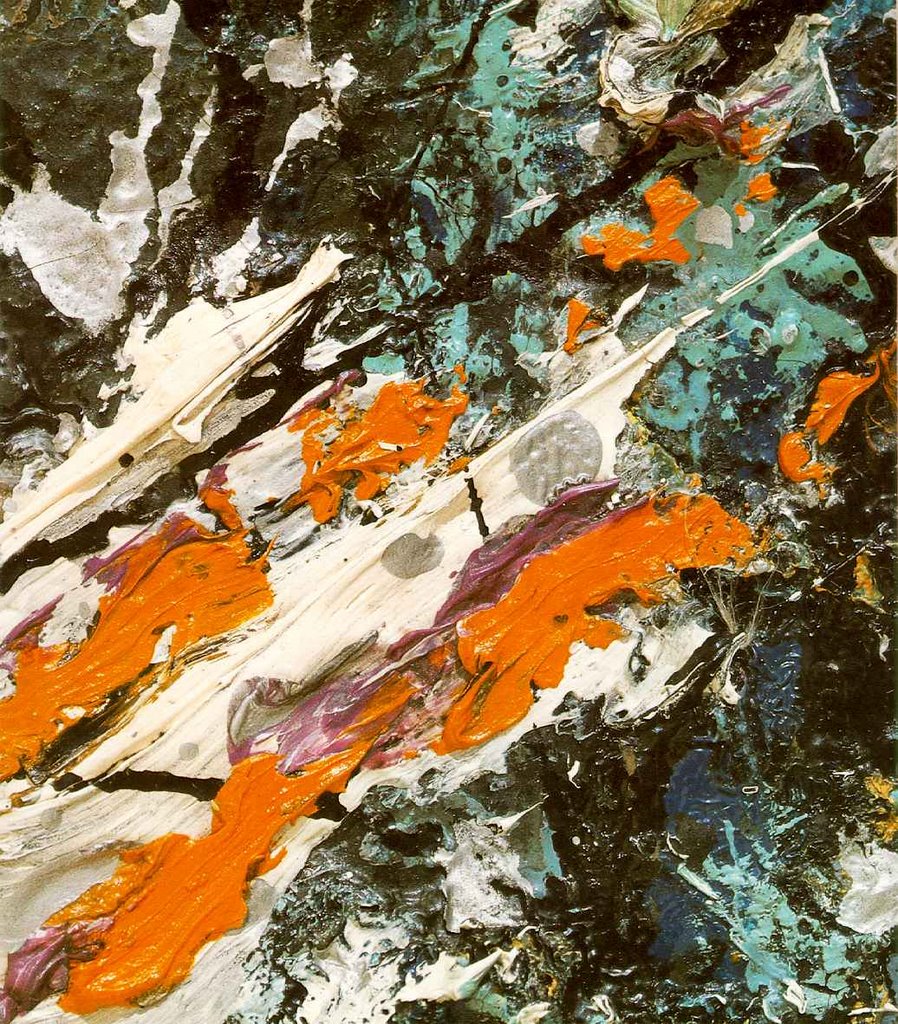
detail of Pollock's Full Fathom Five, 1947

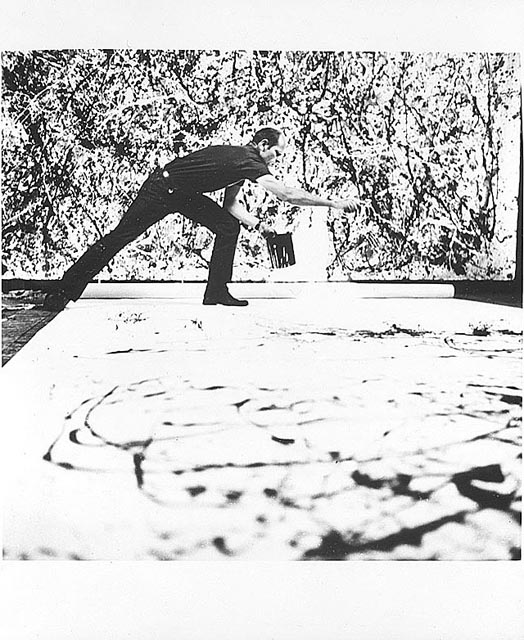
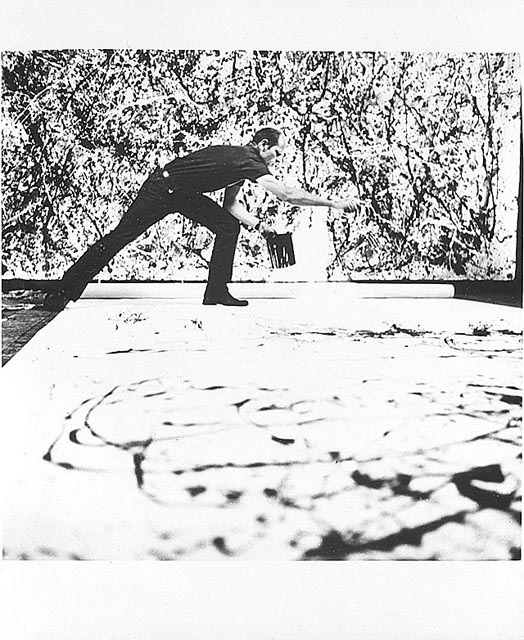
For our purposes, we can focus on Pollock, a figure from modern art much maligned but never ignored. Pollock had a powerful fascination with primal spiritualities that offered mystical connections to the 'essence of being.' In this way, he attempted to use his painting to access the primal aspects of his own being. Often referred to as "action painting," Pollock's practices generated a methodology of painting that placed the greatest emphasis on the very movements or acts that produced the work. Hence, the gesture takes the place of prominence, and the painted canvas is the mere artifact of the art action that took place. Or, in words Jerry Saltz, prominent art critic for the Village Voice in New York, used recently to describe an artist's work from this lineage: "...these paintings are narratives of their own making."
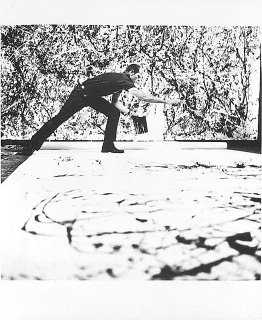

The fresh emphasis upon the artistic gesture ushered in a whole host of new questions about art. Aspects of the work that had always existed in the finished product but had not previously received the attention of the audience; such as the work's duration, location and technique. From these developments, it is not difficult to see how 'performance art' came to be (See Joseph Beuys and Yves Klein). If the gesture is valued more than what it produces, then why not gather the art audience around the gesture(s)? At that point, the audience itself took on a singular importance. Following Marcel Duchamp's notion of "Rendez-vous d'art," the work necessarily involves the observation or participation of an audience. In other words, the gesture always needs a receiver.

With performance art, we see the issue of an artifact or an end product dealt with in various ways. Sometimes the performance generates a piece of work, and sometimes the performance is only recorded through photography or other audio/visual means. In many galleries or museums, you will simply find traces or marks indicating that a work of art took place. Interestingperformanceance art seems to have diverted its future down two different roads; greater prominence for the artist as performer or a quest for increased purity of the gesture.
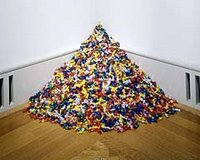
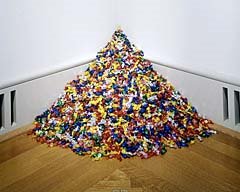
It seems that the 'relational artists' have accepted the latter for their mantle. In many cases, the audience not only experiences but receives the gesture itself or some token of it. Recall here the huge piles of candy that Felix Gonzalez-Torres left in gallery corners as a memorial to Ross. Along these lines, it should be noted that, following cultural theorists like Michel de Certeau, in our post-industrial consumer context the 'gift' proves a much stronger tool for thought than many conventional tactics. At least the form of the work requires a great deal more attention from recipient.

In the case of a recent exhibition at London's Institute of Contemporary Arts by Tino Seghal, I received a very odd giNaivelyvely, I happened upon last chance to catch exclusive new work, a relational art piece consisting entirely of ftravelingling conversations within the gallery. I will recount the experience briefly. Elif- a young girl of ten or eleven, met me at the door to the gallery and escorted me inside. As I observed the barren walls of the gallery, Elif asked me, "What is progress?" After spitting out a few thoughts, I wondered what was happening. Before our conversation had gotten started, Elif passed me off to Fred- a teenager of rare analytical faculties. Fred led me through the guts of the gallery; up the stairs and down the hallways. Before he had finished telling me about a Woody Allen movie I had reminded him of, Johnny entered the discussion. A man of thirty-five or so, Johnny told me several stories about people he had met and things he had read. As we walked, he learned of my studies and was commenting when... he suddenly took off down the stairs! At the bottom, Anne greeted me warmly, like the grandmother she obviously is. She reflected that progress is like a quilt that is patched together out of lots of different pieces. Anne is from the north and actually studied at Durham too. I hadn't even realized that she had led me to the gallery exit when Anne shook my hand and wished me luck. This journey took about twenty minutes.

I would describe this experience as a gift because the only artifact of the work is really the impression it made on me and what I took away. Honestly, four conversations with complete strangers these days is nothing short of an amazing gift. How many strangers do I pass everyday that aren't the least bit interested in telling me about themselves or hearing who I am?

While many would consider it very fortunate that I entered the gallery without any previous bias, I wonder what more I could have shared with these people about myself had I known what was in store. I have tried to envision what participation by Christians in relational art could be. I think it begins with a thoughtful recognition of the importance of the gesture offered and a sincere and honest response to it. Please follow the link to see an encouraging example of a recent artist's subtle, yet powerful use of gestures. See food, flowers and other stories.


3.4.06

video...

For all our technological breakthroughs and
nearly omnipotent potentialities in the digital arts,
why do we not see more examples like this?
Enjoy:

( thanks, katherine )